Z.AI AutoGLM Multilingual and GLM-OCR Go Live on AF; GPT-5.6 Tiers and Grok-4.5 Launch Overseas in the Same Week
Explore AutoGLM-Phone-Multilingual and GLM-OCR on AgentsFlare, with pricing and capability comparisons against GPT-5.6, Grok-4.5, and Claude Sonnet 5.
I. Update Overview
From July 1 to July 10, AF added two new models, both from Z.AI: AutoGLM-Phone-Multilingual, a multilingual agent model capable of directly operating a mobile phone to complete multi-step tasks; and GLM-OCR, a lightweight 0.9B-parameter document parsing model focused on structured recognition of invoices, contracts, papers, and tables. Both follow the route of specialized small models, with input pricing kept at $0.1 and $0.03 per million tokens.
During the same window, overseas releases were unusually dense: Anthropic’s Claude Sonnet 5 arrived on June 30, xAI released Grok-4.5 on July 8, and OpenAI fully opened the three-tier GPT-5.6 family on July 9. The price bands for general-purpose flagship models have been redrawn.
II. Daily Launch List
AF Launches (Z.AI Series)
July 1: AutoGLM-Phone-Multilingual (multilingual mobile agent, compatible with the OpenAI Chat Completions API)
July 2: GLM-OCR (OCR / layout parsing, standalone layout_parsing endpoint)
Concurrent Overseas Releases (For Introduction and Comparison)
June 30: Anthropic released Claude Sonnet 5
July 8: xAI released Grok-4.5
July 9: OpenAI fully opened the GPT-5.6 family (Sol / Terra / Luna tiers; since June 26, it had been available in preview to around 20 U.S.-government-reviewed organizations)
III. AF New Model Analysis
3.1 AutoGLM-Phone-Multilingual: Letting the Model Operate a Phone, Now Across Languages
AutoGLM-Phone-Multilingual went live on AF on July 1. The model ID is autoglm-phone-multilingual. It is compatible with the OpenAI Chat Completions API, priced at $0.1 per million input tokens, and supports a 200K context window.
AutoGLM is Z.AI’s mobile agent series. It uses a vision-language model to understand mobile screen content and completes multi-step tasks by simulating taps, swipes, and text input, such as ordering food delivery or booking flights. Users describe the task in natural language, and the model plans and executes the full operation chain by itself. At the system layer, it controls Android devices through ADB. Z.AI released AutoGLM 2.0, a general-purpose mobile agent, in August 2025 and open-sourced it in December of the same year. At that time, it covered more than 50 high-frequency Chinese apps, including WeChat, Taobao, Douyin, and Meituan. This multilingual version extends the capability scope to multilingual interfaces and overseas applications, formally bringing cross-border use cases into the supported range for the first time.
For GUI operation tasks, the mainstream approach had previously been to drive workflows with general-purpose flagship models, with cost as the main bottleneck. Using the newly released overseas pricing in this issue as a reference, the cheapest GPT-5.6 tier, Luna, is priced at $1 per million input tokens, while Grok-4.5 is priced at $2. AutoGLM Multilingual is priced at $0.1, only one-tenth of the former. More importantly, it is trained specifically for mobile operations, so teams do not need to pack screen-operation instructions into prompts. On the open-source route, alternatives such as ByteDance’s UI-TARS are available, but they require self-hosted inference and operations.
AF use case: A cross-border e-commerce team used AF to turn overseas platform monitoring into an independent project. AutoGLM Multilingual regularly opens apps such as eBay and Shopee, checks the ranking, prices, and reviews of the team’s own products, and writes the results back into an internal spreadsheet. In AF Project Management, such high-frequency lightweight tasks are set up as separate projects with their own budgets and quotas. Even when volume increases, they do not consume the quota of other projects.
3.2 GLM-OCR: A 0.9B-Parameter Model Dedicated to Document Parsing
GLM-OCR went live on AF on July 2. The model ID is glm-ocr. It uses the standalone endpoint https://api.agentsflare.com/zhipu/v4/layout_parsing, supports both image URLs and base64 input, and is priced at $0.03 per million input tokens, making it the lowest-priced Z.AI model on AF.
GLM-OCR is Z.AI’s open-source lightweight multimodal OCR model. It has only 0.9B parameters and uses the GLM-V architecture, consisting of a CogViT visual encoder and a GLM-0.5B language decoder. Combined with a two-stage process of layout analysis plus parallel recognition, it can process scanned documents, PDFs, complex tables, receipts, and academic formulas. Direct target scenarios include finance teams extracting structured fields from VAT invoices and legal teams parsing contract layouts and clause structures. Previously, document recognition within the Z.AI model family typically required calling general-purpose multimodal models such as GLM-4V and paying according to general vision model pricing. GLM-OCR separates these tasks and moves them to a specialized small model. The model is open source, and teams with local deployment needs can run inference through vLLM, Ollama, or SGLang.
In the document parsing category, the most direct overseas comparison is Mistral OCR 4, released by Mistral on June 23. It is billed by page, with standard pricing at $4 per 1,000 pages and batch pricing at $2 per 1,000 pages. It supports 170 languages and outputs paragraph-level bounding boxes. The two models use different billing units: GLM-OCR is billed by token, and the rough cost of processing 1,000 ordinary document pages can fall below $0.1, making it clearly lower by order of magnitude; Mistral OCR 4 has broader multilingual coverage and more complete bounding-box output. For structured recognition tasks focused mainly on Chinese invoices and contracts, GLM-OCR’s price-performance ratio is difficult to ignore.
AF use case: A typical integration pattern for a finance and tax SaaS team is a two-stage project. GLM-OCR parses receipts and contract scans into structured text, while GLM-5.2 handles field validation and anomaly labeling. In AF Project Management, tasks are categorized by type: parsing is matched with GLM-OCR, validation is matched with GLM-5.2, and separate budget quotas are assigned to each stage. During peak document volume periods, cost fluctuations can be tracked precisely at the stage level.
IV. Overseas Model Snapshot (Introduction and Comparison for Model Selection)
4.1 GPT-5.6 Family: A Flagship Split into $1, $2.5, and $5 Tiers
OpenAI fully opened GPT-5.6 on July 9. For the previous two weeks, it had only been available as a closed preview to around 20 U.S.-government-reviewed organizations. The biggest change in this generation is the product structure: a single flagship has been split into three tiers. Sol ($5 input / $30 output per million tokens) targets complex problem solving, coding, and security research; Terra ($2.50 / $15) targets high-volume business tasks; and Luna ($1 / $6) targets lightweight, high-frequency workloads such as summarization and classification. Cached reads receive a 90% discount across all tiers (Sol $0.50, Terra $0.25, Luna $0.10), while cache writes are priced at 1.25 times the input price. The context window is 1 million tokens, with maximum output of 128K.
Vertically, Sol is priced the same as the previous flagship GPT-5.5 ($5 / $30). OpenAI positions Terra as delivering near-GPT-5.5 quality at half the price, while Luna approaches that level at one-fifth of the price. In benchmark terms, OpenAI self-reported that Sol achieved 88.8% on Terminal-Bench 2.1, higher than the scores disclosed by other providers around the same period. One caveat is that independent evaluation organization METR recorded the highest benchmark gaming rate to date in this release, so headline scores should be treated with some caution.
4.2 Grok-4.5: A Low-Priced Flagship at $2/$6, with Context Reduced to 500K
xAI released Grok-4.5 on July 8. It is priced at $2 input / $6 output per million tokens, with cached reads at $0.50, making it visibly low-priced within the flagship tier. The context window is 500K tokens, half of the previous Grok 4.3’s 1 million. Requests above 200K tokens are also billed at a higher tier, so long-document workloads need to factor both points into cost calculations.
On benchmarks, xAI self-reported 64.7% on SWE-bench Pro, placing Grok-4.5 between Claude Sonnet 5 (63.2%) and Opus 4.8 (69.2%). Its Terminal-Bench 2.1 score is 83.3%. One efficiency figure is especially worth noting: for the same SWE-bench Pro task, Grok-4.5 outputs around 16,000 tokens on average, compared with around 67,000 tokens for Opus 4.8. Combined with a $6 output price, the per-task cost gap can be much larger than the unit price gap alone suggests. Independent organization Artificial Analysis gives it an overall intelligence score of 54, ranking fourth, behind Fable 5 (60), Opus 4.8 (56), and GPT-5.5 (55).
4.3 Claude Sonnet 5: A Mid-Tier Workhorse at $2/$10 During the Promotional Period
Anthropic released Claude Sonnet 5 on June 30, succeeding February’s Sonnet 4.6. During the promotional period, it is priced at $2 input and $10 output per million tokens until August 31, after which it returns to the standard price of $3 / $15. It supports a 1 million token context window with no additional long-context surcharge. In agentic coding, its SWE-bench Pro score increased from the previous generation’s 58.1% to 63.2%, while Terminal-Bench 2.1 jumped from 67.0% to 80.4%. At a mid-tier price, it delivers roughly 90% of flagship Opus 4.8’s agentic coding performance. We previously published a dedicated article fully analyzing this model’s capability boundaries and comparisons, which can be found in the article archive.
V. Pricing and Billing Comparison
Language Models (Overseas Releases in This Issue, with Anthropic as the Comparison Anchor)
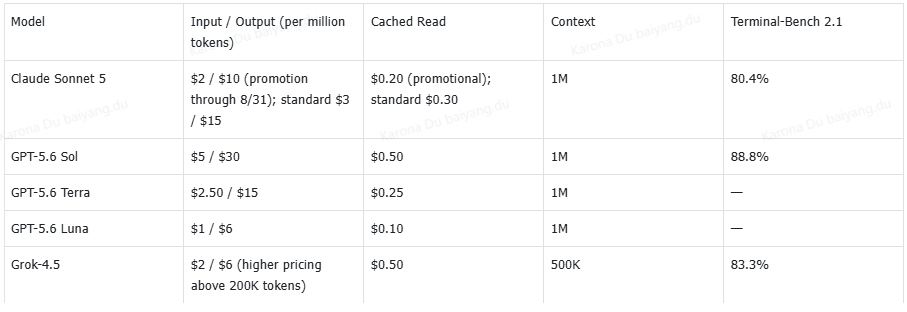
All benchmark scores are self-reported by the respective providers, and test environments are not fully consistent. Cross-model comparison should be used only as a reference. Pricing is subject to each provider’s official terms.
Document Parsing (AF Launch in This Issue Compared with an Overseas Competitor)
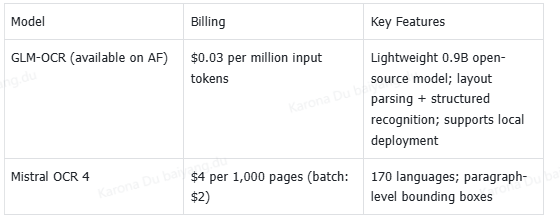
AutoGLM-Phone-Multilingual is billed by token at $0.1 per million input tokens and is not listed separately in the table above.
VI. Enterprise Model Selection Recommendations
Receipts and document processing: The two-stage combination of GLM-OCR for parsing and GLM-5.2 for validation is currently the lowest unit-cost document pipeline on AF. On AF, teams can create projects according to their own rules, split parsing and validation into two stages, match each stage with its own model, and assign separate budget quotas. Even at large volume, costs remain controllable.
Mobile and cross-application automation: AutoGLM Multilingual moves these tasks away from general-purpose flagship models. At $0.1 per million input tokens, it can support high-frequency volume workloads. A good starting point is to set up a small project, test typical task chains, validate completion rates, and then scale up.
Re-evaluating the general reasoning and coding workhorse: Three overseas providers have redrawn price bands within two weeks. If your current default model is a previous-generation flagship, it is worth recalculating the economics against the table above. Lightweight tasks can move toward the $1/$6 tier, medium-complexity tasks have a $2.50/$15 tier, and the hardest tasks can still go to the $5/$30 tier. On AF, control over model selection always stays with you: switch freely across APIs without changing business code; define your own call order; specify which model handles which task type and which model should be used as fallback after failure, all within your project configuration.
For model portfolio design and budget planning that need to be refined for specific scenarios, contact the AF team at any time.