2026 Global Artificial Intelligence Ecosystem Panorama: Model Intelligence Evolution, Compute Supply-Demand Mismatch, and the Deep Transformation of Agentic Architectures
GPT-5.4, Claude 4.6, Qwen 3.5, long-context agents, GPU shortages, and energy constraints show enterprise AI moving from model scale toward ROI, inference efficiency, and governable workflows.
In March 2026, the global artificial intelligence ecosystem is standing at a highly critical turning point. According to the latest forecast from the authoritative research institution Gartner, global AI spending in 2026 is expected to reach $2.52 trillion, an increase of 44% from 2025. This enormous flow of capital indicates that AI infrastructure construction has moved from the early experimental stage toward large-scale industrial deployment. However, behind the investment boom, the market is also going through a “Trough of Disillusionment”: enterprise decision-makers are no longer blindly pursuing model scale, but are instead shifting their focus toward provable return on investment(ROI), extremely high inference efficiency, and intelligent agents(Agents)that can truly handle complex workflows.
Chapter 1 Cognitive Leaps and Architectural Competition among Top Model Vendors
During this week, updates from the world’s leading model vendors reveal a clear signal: pure competition over parameter scale has given way to “inference-time compute” and “long-context state management.” This shift is intended to solve the reliability problems that large language models(LLMs)face when handling long-running tasks.
1.1 Reasoning Enhancement and Real-Time Adaptation among Closed-Source Giants
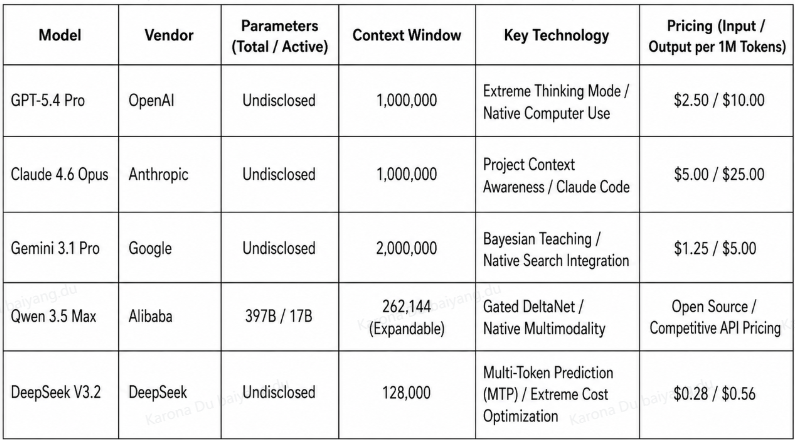
OpenAI’s GPT-5.4, released this month, marks another leap in logical reasoning capability. The model introduces an “Extreme Thinking Mode,” allowing the model to consume more inference compute resources when handling complex problems. This mechanism effectively improves the model’s reliability in tasks lasting several hours and reduces the error rate in long chains of logic. In addition, the 1-million-token context window provided by GPT-5.4 places it in the same tier as Google and Anthropic in terms of information-processing capacity.
Unlike OpenAI’s emphasis on logical depth, Google’s research this week focused on breakthroughs in LLMs’ ability to perform “belief updating.” The “Bayesian Teaching” training method introduced by Google researchers aims to teach models to update their internal probability distributions in real time based on newly emerging evidence. This approach addresses a common limitation of AI agents: traditional models often treat each interaction independently and cannot adaptively adjust based on new signals provided by the user. In evaluation benchmarks, models trained with Bayesian methods achieved 81% accuracy in recommendation tasks, significantly outperforming traditional models. At the same time, Google’s released Gemini 3.1 Flash-Lite locked onto the large-scale developer market with highly competitive pricing($0.25 per million input tokens).
Anthropic’s Claude 4.6 series continues to focus on enterprise-level complex reasoning and “computer use” capabilities. Claude 4.6 emphasizes Project Context Awareness, and, together with the Claude Code CLI tool, further strengthens its leading position in software engineering.
1.2 Architectural Innovation among Open-Source Players and the “Chinese Breakthrough”
The open-source model field showed strong innovation momentum this week. Vendors represented by Alibaba and Ai2, in particular, challenged the efficiency bottleneck of the traditional Transformer architecture through fundamental architectural changes.
Alibaba’s Qwen 3.5 series(including the 397B flagship version and multiple smaller-parameter versions)caused a stir in the technical community. Qwen 3.5 adopts an innovative design called “hybrid linear attention,” combining standard quadratic attention heads with Linear Attention Heads, greatly reducing VRAM usage when processing long contexts. Its flagship model, Qwen 3.5-397B-A17B, adopts a Sparse MoE architecture. Although the total parameter count reaches 397B, only 17B parameters are activated per token. This allows it to run on quantized systems with only 48 GB to 96 GB of VRAM, far below the 800 GB requirement of dense models at the same level.
More notably, Alibaba has officially removed the “VL” suffix from its multimodal models. In the Qwen 3.5 era, all models achieve native multimodal capability through Early Fusion training. This means that text, images, and video are jointly learned within the same representation space, rather than being simply stitched together through downstream adapters.
Meanwhile, the Olmo Hybrid model family released by the Allen Institute for AI(Ai2)demonstrated another path to efficiency. By combining Transformer attention layers with Linear Recurrent Layers, Olmo Hybrid achieved the same accuracy as Olmo 3 on benchmarks such as MMLU while using 49% fewer tokens. This hybrid architecture shows extremely high cost-effectiveness when handling ultra-long contexts.
Chapter 2 The Productivity Evolution of the AI Technology Stack and Agent Orchestration Frameworks
2026 is regarded as the breakthrough year for multi-agent systems(MAS). The market is moving away from simple prompt-based interaction and toward “digital assembly lines” completed collaboratively by multiple specialized agents.
2.1 Orchestration Frameworks: Returning from Abstract Expansion to Engineering Practicality
On GitHub, competition among agent orchestration frameworks is shifting from feature accumulation toward reliability and debuggability. LangChain’s “Deep Agents” represents the latest iteration of this trend. Deep Agents is designed as an “Agent Harness” built on top of the LangGraph runtime, specifically for handling multi-step, stateful tasks that require heavy human involvement. Its core innovation lies in file-system-based context management: by offloading large volumes of data to the storage backend rather than stuffing everything into the active prompt, it effectively prevents context overflow.
However, in frontline technical communities such as Reddit and X, many CTOs and chief architects have expressed caution toward excessive framework abstraction. A trend of “returning to simplicity” is emerging: developers increasingly prefer to build systems using native APIs(such as the Claude API), Redis-based state management, and simple Python scripts, rather than relying on complex orchestration layers. They believe that the extra abstraction introduced by frameworks often becomes the biggest obstacle when debugging production incidents at two in the morning.
2.2 GitHub Popular SOTA Trends and Core Infrastructure Tools
AI projects on GitHub are becoming highly specialized and segmented. Beyond traditional generative projects, tools focused on agent memory management, data ingestion, and environment isolation have become new favorites among developers.
• OpenClaw and OpenViking: The OpenClaw project, which has sparked enthusiasm in the Chinese developer community, and its supporting context database OpenViking, uses a file-system paradigm to unify the management of memory, resources, and skills required by intelligent agents, enabling layered context delivery.
• Cognee: As a knowledge engine focused on persistent memory for agents, Cognee combines vector search with graph databases to achieve “cognitive-science-grade” memory storage. Complex context retrieval can be implemented with only six lines of code.
• InsForge: This is a backend development platform specifically designed for AI coding agents. It acts as a semantic layer between agents and traditional backend primitives (databases, storage, authentication), enabling agents to understand and operate complex backend logic.
2.3 Inference Acceleration Engines: Coordinated Optimization between Blackwell and DeepSeek
As the NVIDIA Blackwell architecture(B200/B300)is gradually deployed, updates to inference acceleration engines are shifting toward low-bit quantization and Disaggregated Serving.
NVIDIA’s TensorRT-LLM v1.2.0 significantly enhances support for B300 hardware, fully enabling the SM120 and SM103 paths. Of particular note, this version deeply optimizes DeepSeek V3.2, enables support for Multi-Token Prediction(MTP > 1), and achieves world-class inference performance under FP4 quantization. In addition, the newly introduced Disaggregated Serving mechanism allows KV Cache to be dynamically scaled and transferred across different nodes, greatly improving the response speed of ultra-large models under concurrent workloads.
Chapter 3 AI Physical-Layer Infrastructure: Silicon Shortages and the Rise of Energy Sovereignty
Although model algorithms continue to advance, the supply-demand mismatch in physical-layer infrastructure has become the primary contradiction limiting the growth rate of the AI industry.
3.1 Current GPU Supply and Demand: MSI’s Warning and Compute-Cost Volatility
In its March 2026 investor briefing, MSI disclosed that NVIDIA is currently supplying approximately 20% fewer GPUs than market demand. This shortage is not limited to the high-end H100/B200 series; it has even spread to consumer-grade and mid-range gaming cards. MSI expects 2026 to be “the most difficult year since the company’s founding,” due not only to the GPU supply gap, but also to sharp volatility in memory prices.
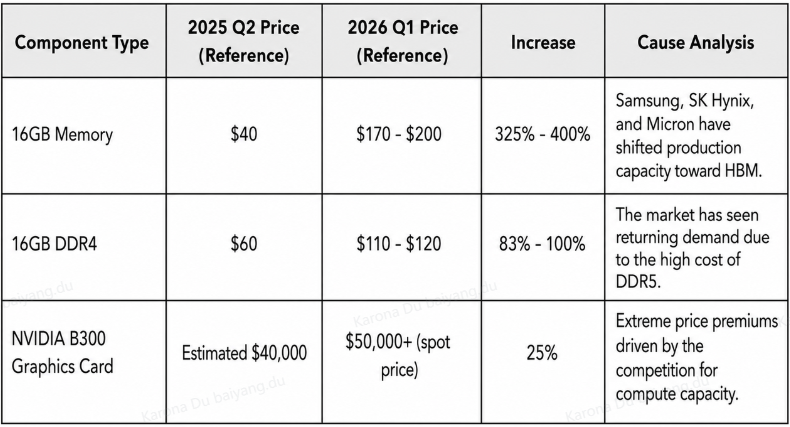
Against this backdrop, the computer rental market is showing a polarized pattern. On the one hand are traditional cloud giants such as AWS, Azure, and Google Cloud, where B300 instance rental prices are as high as $19.00 to $23.00 per hour. On the other hand, there are emerging AI cloud providers represented by Spheron and Nebius, which use extremely lean virtualization layers and efficient energy management to push prices down to $3.50 to $6.99 per hour.
3.2 Energy Anxiety and the Nuclear Race: Attempts to Move Off the Grid
Compute centers’ appetite for electricity has reached a point that traditional power grids can hardly bear. JLL’s report shows that, in large data center markets, the waiting time for new facilities to connect to the grid is now close to five years. To bypass this bottleneck, technology giants are launching an unprecedented process of “nuclear privatization.”
• Microsoft and Three Mile Island: Microsoft signed a 20-year, $16 billion agreement to support Constellation Energy in restarting Unit 1 of the Three Mile Island nuclear power plant. The 835 MW of electricity generated by this unit will be fully reserved for Microsoft.
• Google and Small Modular Reactors(SMR): Google signed the world’s first agreement with Kairos Power to develop a cluster of small modular reactors, with plans to deploy a total of 500 MW of nuclear-powered compute infrastructure by 2030.
• Meta’s 6.6GW Nuclear Strategy: Meta announced an ambitious nuclear power procurement plan, involving the purchase of 20 years of electricity from three Vistra nuclear power plants and direct participation in TerraPower’s technology development.
This trend toward vertical integration suggests that future AI competition will not only be a competition over code and data, but also a competition over stable, low-carbon, and controllable energy.
Chapter 4 Market Adoption and Signal Layer: From “Vibe Coding” to Architectural Selection Competition
On the enterprise application side, AI deployment data demonstrates real productivity gains, but also reveals deeper structural problems.
4.1 The Rise of “Vibe Coding” and the Developer Dilemma
“Vibe coding” was named Word of the Year by Collins Dictionary at the end of 2025, and by 2026 it has become a production method for millions of people. Its core logic is that users only need to describe their intent, and AI agents are responsible for implementation.
• Adoption rate: Surveys show that 92% of U.S. Developers currently use AI tools every day, and 41% of code globally is generated by AI. By the end of 2026, this share is expected to rise to 60%.
• Efficiency miracle: AT&T reported that, through AI enablement, internal data products that originally required six weeks to complete can now be produced in just 20 minutes.
• Hidden risks: Although productivity has surged, security risks remain. GitHub research indicates that AI-generated code improves readability by 13.6%, but approximately 29.1% of AI-generated Python code contains potential security vulnerabilities.
4.2 The Architecture Debate: Has RAG Really Been Killed by Long Context?
As the context windows of the Gemini and GPT series continue to expand, the claim that “retrieval-augmented generation(RAG)is dead” once became popular. However, frontline decision-maker research in March 2026 revealed a completely different reality.
Why does RAG remain the preferred architecture?
Cost difference: The average cost of a pure long-context query is $0.10, while a RAG query costs only $0.00008, a difference of 1,250 times.
Latency challenge: Processing million-token inputs typically creates latency of 30 to 60 seconds, which is unacceptable for production environments such as real-time customer service.
Accuracy degradation: The “Lost in the Middle” finding remains valid. Even top-tier models see retrieval accuracy decline by more than 30% when handling fully loaded million-token contexts.
Therefore, the current consensus is “state-aware retrieval.” This is a hybrid architecture that treats RAG as the “disk”(storing massive knowledge)and the long-context window as “memory”(handling complex details of the current session).
4.3 CTO Decision Preferences: A Tribute to “Mediocre Architecture”
In professional communities such as r/AI_Agents and r/LLMDevs, the architecture-selection trend in 2026 can be summarized as “deliberately staying mediocre.” Senior architects have found that a segmented, narrow-domain “constellation of small agents” with clear task boundaries performs far better than a powerful all-purpose agent. This “atomic” architectural strategy not only reduces debugging costs, but also mitigates LLM hallucinations through deterministic workflows.
In addition, enterprises’ emphasis on “sovereign AI” and privacy has led to the phenomenon of “geopatriation.” Gartner predicts that by 2030, more than 75% of enterprises in Europe and the Middle East will move virtual workloads back to local or sovereign clouds in order to avoid geopolitical risks.
Conclusion: Finding Real Leverage in Disillusionment
By March 2026, the AI ecosystem has already moved beyond pure fantasy. The market is reshaping the industry through cold mathematical logic and physical constraints (compute, energy, and cost).
At the model layer, architectural innovation (such as sparse mixture-of-experts and linear attention)is offsetting the pressure caused by rising compute costs. At the technology-stack layer, engineering practice is moving back from complex framework abstraction toward simple, controllable primitive designs. At the infrastructure layer, technology giants’ competition for nuclear energy indicates that the AI race has entered an era of resource sovereignty.
For enterprise decision-makers, the core question in 2026 is no longer whether to adopt AI, but how to build closed-loop systems with real business value under the physical constraints of GPU shortages and soaring memory prices, through vibe coding and state-aware retrieval architectures. The next evolution of AI will no longer happen only on silicon chips; it will also happen across energy grids, code-review processes, and every digital assembly line reshaped by AI agents.