Global AI Infrastructure Industry Observation Report, February 26 to March 5, 2026: Compute Premiums under Physical Bottlenecks, Agentic Transformation, and Geopolitical Regulation
GPT-5.2, Gemini 3.1, DeepSeek V4, GPU delivery delays, cooling limits, and AI regulation show enterprise AI shifting from model choice to cost-aware gateways, rollback controls, and auditable deployment.
Industry Overview: The Infrastructure Era Shifts from “Model Hallucination” to “Physics and Pipelines”
During the observation week from February 26 to March 5, 2026, the global AI infrastructure industry showed a profound shift from simply pursuing parameter scale toward pursuing “unit inference efficiency” and “physical-layer reliability.” According to NextAI+’s observational data and market analysis, 2026 is regarded as the year when artificial intelligence enters the “trough of disillusionment,” but this does not signal an industry contraction. Instead, it points to a more rational expansion of compute infrastructure based on return on investment (ROI). Gartner’s latest data show that total global AI spending in 2026 is expected to reach $2.52 trillion, up 44% year on year, of which spending on AI-optimized servers has increased by 49% and accounts for 17% of total spending; infrastructure alone contributes approximately $401 billion.
The most significant feature this week is the full return to the law of “physics and pipelines.” This means that latency, data localization, system reliability, and the hidden costs of retrieval and tool calling have become core variables determining the success or failure of enterprise-level AI applications. Model vendors no longer merely advertise benchmark scores, but have begun to move deeper into underlying hardware, power facilities, and even physical cooling technologies in order to maintain performance in extremely high-pressure production environments.
Part I: Dynamics among Model Giants and Cloud Providers: Agentic Protocols and the Competition for Compute Sovereignty
Agentic Upgrades of Flagship Models: GPT-5.2, Gemini 3.1, and Claude 4.6
In this week’s scan, leading model vendors showed a strong “agent-oriented” tendency. The GPT-5.2 series released by OpenAI in early February has become the preferred choice for enterprise-level agent development. The series not only improves the depth of logical reasoning, but more importantly introduces the “Reasoning Effort” parameter, allowing developers to dynamically adjust between “none” (low latency) and “xhigh” (deep thinking). This creates room for fine-grained cost scheduling at gateway layers such as AF.
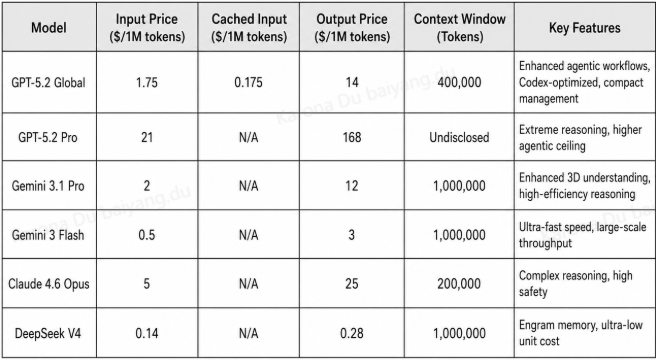
Google showed an aggressive generational-switching posture this week. On February 26, Google officially launched Nano Banana 2 and Gemini 3.1 Flash Image Preview, emphasizing improved processing capability in high-concurrency scenarios while maintaining high precision. At the same time, Google announced that it would forcibly shut down the Gemini 3 Pro preview version on March 9, pushing developers to migrate to Gemini 3.1 Pro, whose performance has improved by 15%. However, this rapid lifecycle iteration has also raised community concerns about model degradation, such as the loss of humor and response timeouts.
DeepSeek V4 and the “Efficiency Paradox”: China’s Breakthrough in Compute Infrastructure
Chinese vendor DeepSeek became a focal point in global discussions of infrastructure costs this week. The long-rumored DeepSeek V4 is expected to be officially released around March 5, and its trillion-parameter (1T) mixture-of-experts (MoE) architecture has shown striking efficiency in leaked details: although the total parameter count has increased, only about 32B parameters are activated per token, which means its operating cost may be lower than that of the previous-generation V3. DeepSeek’s key technical breakthrough lies in its “Engram conditional memory layer,” which allocates 75% of sparse capacity to dynamic reasoning and 25% to static lookup, achieving O(1) knowledge retrieval under a 1-million-token ultra-long context.
Compute Expansion and Geopolitics: A $110 Billion Arms Race
Infrastructure expansion is accompanied by astronomical capital investment. This week, OpenAI announced that it had secured a new round of financing worth $110 billion and deepened its compute partnership with AWS, reflecting top model vendors’ intense desire for “compute sovereignty.” Echoing this, Meta signed an AMD AI chip procurement agreement worth $100 billion, aiming to reduce its dependence on Nvidia as a single supply source. This move directly pushed the adoption depth of the AMD MI350 series on the market.
Part II: AI Technology Stack and Open-Source Engineering Progress: From Inference Engines to Gateway Hubs
Extreme Optimization of Inference Engines: An In-Depth Analysis of vLLM v0.16.0
This week, the open-source inference engine vLLM reached a milestone with version v0.16.0. By introducing a combination of Async Scheduling and Pipeline Parallelism, this version achieved a 30.8% improvement in end-to-end throughput and a 31.8% improvement in TPOT (Time Per Output Token).
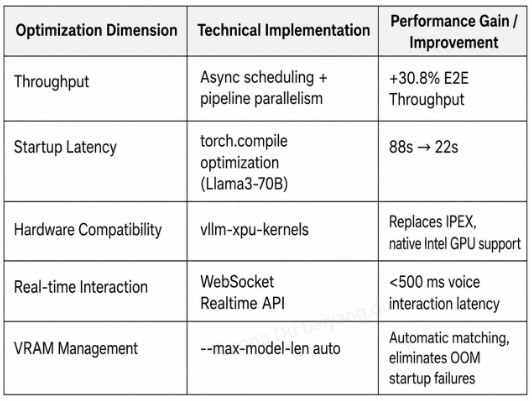
In addition, vLLM’s support for RTX Blackwell (SM120) workstation-class graphics cards has been fixed, especially support for the NVFP4 MoE kernel, making it possible to deploy ultra-large-scale MoE models on consumer-grade and quasi-enterprise-grade hardware.
Agent Frameworks and Persistent Memory: Beads, LangGraph, and Multi-Agent Collaboration
GitHub trends show that the development focus of AI agents is shifting from “single-step prompting” to “long-horizon execution.” The Beads system developed by Steve Yegge attracted significant attention this week. It stores agents’ tasks, plans, and dependencies through a Git backend, solving the problem of agents “forgetting” in long conversations. This indicates that agent frameworks are evolving toward “digital assembly lines.” Databricks reports that multi-agent collaboration systems have grown by 327% over the past four months.
Enterprise-Level Gateways: The Rise of a New Control Plane
As the number of model types surges, enterprises have discovered that the infrastructure challenge is no longer “which model to choose,” but how to govern traffic. The AI Gateway was defined this week as a “must-have” for enterprise-level infrastructure. Gateway systems represented by Bifrost (Maxim AI) can achieve multi-vendor switching with extremely low overhead of 11 μs through Semantic Caching and Circuit Breaker mechanisms.
The Core Mathematical Logic of Gateway Scheduling
When conducting multi-model routing, gateways usually follow a cost-quality optimal path. Suppose model Mi has response quality Qi, unit token cost Ci, and current latency Li. The gateway’s scheduling function f(req) can be expressed as:
f(req) = argmin_i (ω1Ci + ω2Li - ω3Qi)
Where ω is the weight coefficient based on business priority. This week’s trend indicates that, as model performance across vendors converges, the share of weight ω1 (cost) in non-core tasks has increased significantly.
Part III: AI Physical-Layer Compute and Hardware Infrastructure: Performance Breakthroughs in Extreme Environments
The Normalization of Compute Shortage: A Long Wait of 36 to 52 Weeks
Despite massive investment, the structural shortage in the hardware supply chain reached its peak in early 2026. Delivery cycles for data-center GPUs, such as H100 and MI250, have now stretched from 9 months to one year. This shortage is pushing enterprises toward diversification into “XPUs”; currently, 31% of enterprises are evaluating TPUs, and 26% are evaluating AWS Trainium.
The Generational Leap in Thermal Management: Liquid Cooling and Diamond Cooling
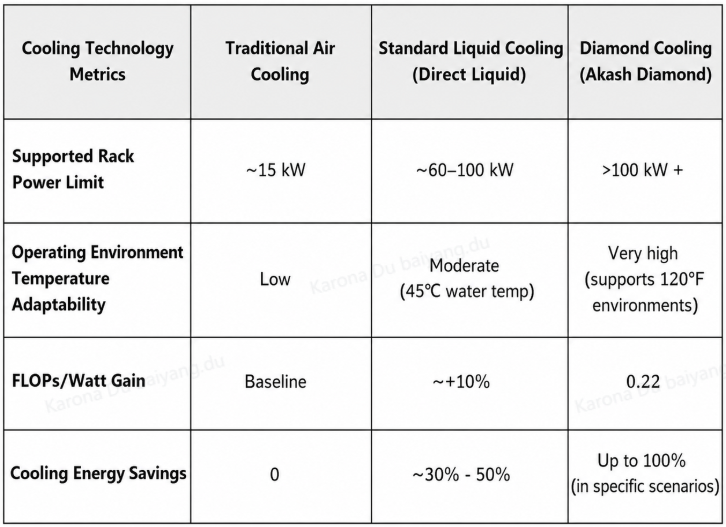
As rack power density has surged from 7kW in 2021 to an average of 27kW in 2026, thermal management technology has become the decisive factor in AI infrastructure. Super Micro Computer is locking in long-term profits by shifting toward liquid-cooling infrastructure, especially after Nvidia’s Vera Rubin platform made liquid cooling a “mandatory requirement.” SMCI’s inventory strategy gives it an advantage over peers in delivery speed.
On March 3, 2026, Akash Systems released the world’s first AI server based on “diamond cooling” technology. Diamond has five times the thermal conductivity of copper. With this technology, the operating temperature of the MI350X GPU was reduced by 10°C, and token throughput in high-temperature environments increased by 15%.
The Surge in Power Demand: The Return of Heavy-Duty Gas Turbines
The end point of compute infrastructure is electricity. Mitsubishi Power noted that demand for heavy-duty gas turbines in the Americas has increased sixfold in the past five years, directly reflecting data centers’ urgent need for large-capacity, highly reliable power. Analysts estimate that total power demand from AI data centers has jumped from the hundreds-of-megawatts level in 2023 to the tens-of-gigawatts level in 2026.
Part IV: Global Governance and Compliance Regulation: From Drafts to Substantive Enforcement
The EU AI Act: Compliance Pain under the Enforcement Countdown
2026 is a core year for the phased implementation of the EU AI Act. By August 2, 2026, transparency requirements and rules for “high-risk AI systems” (HRAI) will fully take effect. Enterprises must embed compliance audits at the design stage, because the maximum fine has been set at 7% of global annual turnover.
2026 Compliance Focus Areas
· GPAI Code of Practice: The code of conduct for general-purpose AI models was finalized in 2025. This week, vendors including Aleph Alpha, MistralAI, and OpenAI signed it, committing to greater transparency in safety and copyright.
· Digital Simplification Package: The EU is discussing adjustments to the grace period for high-risk systems, potentially extending some compliance deadlines to December 2027 in order to ease pressure on enterprises.
China and Asia-Pacific: The Deepening of Data Localization and Labeling Rules
Since China’s Measures for the Administration of Labeling of Generative Artificial Intelligence have been implemented in September 2025, stronger enforcement has become visible this week. Platforms are required to implement multiple forms of labeling, including audio Morse code and encrypted metadata, to ensure that the authenticity of synthetic content is traceable. At the same time, China’s newly revised Arbitration Law took effect on March 1, formally recognizing the legal validity of AI-assisted online arbitration.
“Machine Unlearning” and New Governance Challenges
As privacy regulations deepen, a new technical challenge has emerged in governance in 2026: Machine Unlearning. Traditional database deletion requires only one command, but once an AI model has been trained on specific user data, how to “completely erase” the influence of that data from neural-network weights has become an important part of compliance audits.
Part V: Market Adoption and Public Opinion: ROI Audits under a Rational Return
The “Physical Reality” in the Trough of Disillusionment
Public opinion is undergoing a shift from “Demo Fever” to “Production Chill.” The market is no longer impressed by polished video-generation demos, and is instead focusing on the system’s “physical reality”: Does latency support real-time interaction? Does the unit token cost allow large-scale deployment?
Three Laws of Enterprise Adoption in 2026
1. No Agent without Rollback: Any agent system with autonomous decision-making capability will not be allowed into production if it cannot prove that it has “Undo” and “Rollback” capabilities.
2. Blast Radius Control: At the gateway layer, enterprises must forcibly limit the number of records, dollar amount, or customer scope that an AI agent can touch in a single operation.
3. Synthetic Data Leverage: Enterprises are using Synthetic Data at scale to bypass privacy-protection and data-scarcity problems, and this has become a common method for enterprises in 2026 to avoid high compliance costs.
Public Opinion: Resistance to the “Subscription Tax” and “Model Fragmentation”
Developer sentiment on social media, such as Reddit, shows that severe tool fragmentation is becoming a productivity killer. Developers have begun to resent the “subscription tax” (paying hundreds of dollars per month to different API vendors) and are calling for a “Holy Grail Setup.” At the same time, public opinion shows clear distrust toward practices by vendors such as Anthropic that may lower safety standards because of market competition.
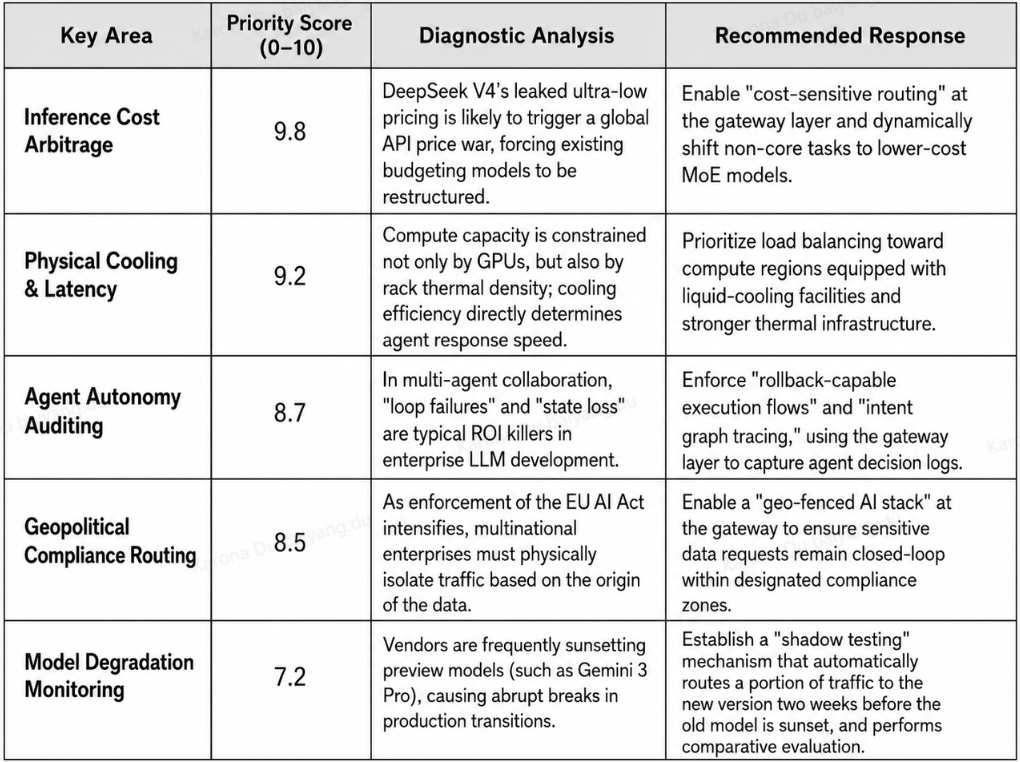
Part VI: AF Gateway Observer -- Priority Scoring and Diagnostic Analysis
Based on this week’s global scan, the AgentsFlare gateway’s priority scoring for enterprise-level AI infrastructure management is as follows:
Part VII: Creative Research Topic -- Frontier Proposal for Enterprise-Level Gateway Scheduling
Topic Name: Sovereignty-Aware “State-Aware Asynchronous Routing” (SAAR)
Research Background
As AI agents shift from single-step requests to multi-step collaboration lasting several hours, gateways face a new problem: the uneven distribution of “state weight” in long-horizon conversations. The first 80% of a conversation may be only information collection, while the key 20% is the decision logic. Current gateways cannot perceive this “state importance,” causing enterprises to waste expensive high-end model compute even during the information-collection stage.
Core Proposal
For gateways such as AgentsFlare, research a scheduling protocol that can identify the “stage-specific weight” of agent tasks in real time:
1. Stage Predictor: Use an ultra-lightweight model, such as GPT-5.2 nano, to determine within milliseconds whether the current request belongs to “data collection,” “logical modeling,” or “high-risk decision-making.”
2. Asynchronous Compute Drift: For the “data collection” stage, the gateway automatically routes context to DeepSeek V4 or a local Llama 4 Maverick cluster, using its ultra-long context and low-cost characteristics.
3. High-Value Interruption: When the task is detected to have entered “high-risk decision-making” (involving fund allocation or compliance clauses), the gateway immediately triggers a Hot Swap, synchronizes the state to GPT-5.2 Pro or Gemini 3.1 Pro, and enables Two-Step Verification.
4. Cross-Time-Zone Energy-Efficiency Arbitrage: In combination with global electricity prices and carbon quotas, the SAAR protocol can automatically schedule long-horizon asynchronous tasks (non-real-time) to geopolitical nodes that are currently in a power-price trough or have surplus clean energy.
Expected Impact
This proposal is expected to reduce the cost of complex enterprise-level agent workflows by 45% or more. At the same time, because it reduces ineffective load on high-end models, overall system throughput during peak hours will increase by 30%.