grok-4.6 Matches GPT-5.6 Sol at $2 Input Pricing, MiniMax-H3 Brings 2K Video to $0.13/Second: AF Model Update for the First Half of August
Author
Agentsflare Admin
Date Published
AF added 4 new models in this issue. Google’s gemini-3.5-flash-lite went live on August 6 with a 1M-token context window and 350 token/s output speed, while Terminal-Bench 2.1 improved from 31% on the previous Flash-Lite generation to 54%. MiniMax’s native video model MiniMax-H3 launched on August 7, generating up to 15-second 2K video with native stereo audio at $0.13 per second for 2K. On August 13, Alibaba’s Tongyi text embedding model text-embedding-v4 went live together with the /v1/embeddings endpoint, priced at $0.07/1M input tokens. xAI’s grok-4.6 also launched the same day with a 500K context window, an Artificial Analysis Intelligence Index score of 61—tied with GPT-5.6 Sol—and a $2.00 input price.
On retirements, claude-opus-4-1-20250805 reached end of life on August 5, while the grok-4-1-fast-reasoning and grok-4-1-fast-non-reasoning slugs were retired on May 15 according to xAI’s official schedule. Another 10 models now have announced retirement dates ranging from the end of August through June 2027. The nearest deadline is August 31; migration recommendations appear later in this article.
If you read nothing else this week:
- AgentsFlare added four models in the first half of August: xAI’s Grok 4.6, Google’s Gemini 3.5 Flash-Lite, MiniMax-H3 for video generation, and Alibaba’s text-embedding-v4, alongside the new /v1/embeddings endpoint.
- Grok 4.6 brings frontier-level capability at a lower price: for prompts within 200K tokens, it is priced at $2 per million input tokens and $6 per million output tokens. Its Artificial Analysis Intelligence Index score of 61 matches GPT-5.6 Sol, making it suitable for long-horizon agents, research, and multi-step coding tasks.
- MiniMax-H3 and Gemini 3.5 Flash-Lite target video and high-throughput workloads: H3 generates up to 15-second 2K videos with native stereo audio at $0.13 per second, while Gemini 3.5 Flash-Lite offers a 1M-token context window and around 350 tokens per second for large-scale batch processing and agent subtasks.
- The update also expands embedding support and model migration options: text-embedding-v4 costs $0.07 per million input tokens, supports more than 100 languages and configurable vector dimensions, while several legacy Claude and Grok models have already been retired or received retirement dates and should be migrated in advance.
New Models by Date
August 6: gemini-3.5-flash-lite (lightweight model in Google’s Gemini 3.5 family, model ID gemini-3.5-flash-lite)
August 7: MiniMax-H3 (MiniMax native video generation model, model ID MiniMax-H3, with H3-Context-IR prompt enhancement)
August 13: text-embedding-v4 (Alibaba Tongyi text embedding model, model ID text-embedding-v4), with the /v1/embeddings endpoint going live
August 13: grok-4.6 (xAI Grok flagship, model ID grok-4.6)
grok-4.6: $2.00 Input Pricing, Matching GPT-5.6 Sol on the Intelligence Index
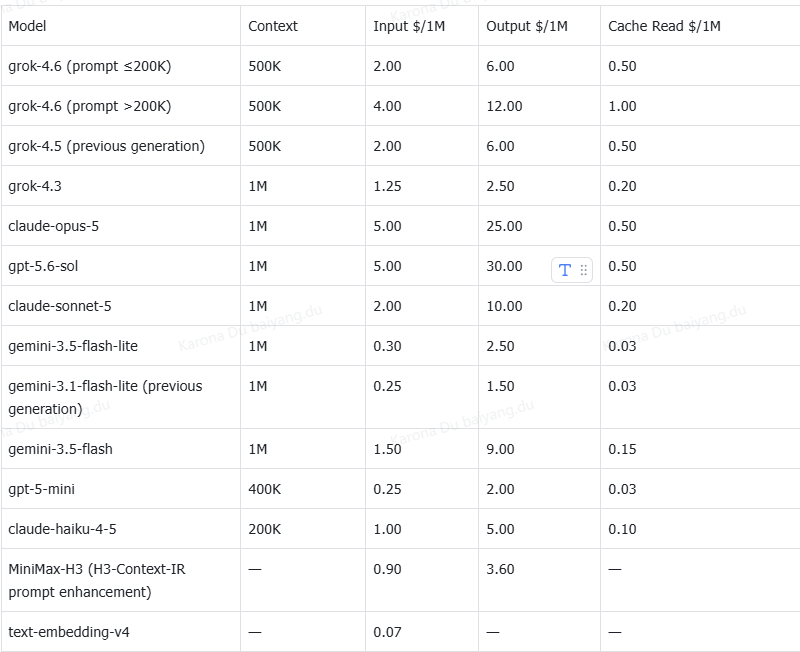
xAI released grok-4.6 on August 12, and AF added it on August 13. It is compatible with the existing OpenAI Chat Completions API and supports both a 500K-token context window and a 500K maximum output. Pricing is tiered by context length: when the prompt in a single request is 200K tokens or less, input costs $2.00/1M, output $6.00/1M, and cache reads $0.50/1M. Once the prompt exceeds 200K, the entire request is billed at $4.00/1M input, $12.00/1M output, and $1.00/1M cache reads. One easy trap is that the higher tier applies to the entire request: a 210K-token request is billed entirely at the higher rate rather than charging only the excess 10K at the higher price. For long-context workloads, keeping prompts below 200K cuts the unit cost in half.
Compared with grok-4.5, the most practical change is that pricing has not moved. Both generations are priced at $2.00/$6.00 and both support a 500K context window. xAI added a further round of training, rebuilt SFT trajectories, and applied agentic reinforcement learning across coding, web development, CAD, and kernel optimization. According to xAI, the model shows more self-checking and verification behavior on long-horizon tasks. The lower-tier grok-4.3 remains available at $1.25/$2.50, with a 1M context window and 30K maximum output. The division of labor is clear: grok-4.3 is more economical for bulk workloads that mainly need long-context ingestion with limited output, while 4.6 is better suited to tasks where the model must execute multiple steps and verify its own work along the way.
In the broader market, grok-4.6 has a clear position. It scores 61 on the Artificial Analysis Intelligence Index, tying GPT-5.6 Sol and trailing Fable 5 by one point; it scores 1753 on GDPval-AA v2, 69.9% on CursorBench v3.2, and 65.9% on DeepSWE v1.1. Performance is mixed by benchmark: it leads GPT-5.6 Sol on GDPval-AA, AA-Briefcase, and Harvey LAB, while trailing on DeepSWE and Terminal-Bench. The bigger differentiator is price. Within the same 61-point performance tier, GPT-5.6 Sol is priced at $5.00/$30.00 and claude-opus-5 at $5.00/$25.00, while grok-4.6 costs $2.00/$6.00—two-fifths of their input price and only one-fifth to one-quarter of their output price.
The safety picture also needs to be stated clearly. xAI published the grok-4.6 model card alongside the model on August 12. Its adversarial evaluations test whether refusal guardrails fail under pressure, with refusals implemented through a layered mechanism combining safety fine-tuning and post-training. Critics have also noted that capability benchmarks are published in considerable detail while safety conclusions are often compressed into one or two sentences, and independent third-party testing typically arrives later. Within hours of grok-4.5 launching on July 8, jailbreak researchers had already published screenshots showing bypasses. These findings need to be interpreted carefully: jailbreak tests probe the refusal boundary of the base model, which is not the same as production risk after content moderation, tool allowlists, and output filters are layered on top. Before putting grok-4.6 into an external-facing product, it is advisable to run a separate red-team exercise against your own business red lines rather than relying on a single vendor or third-party score.
The model is best positioned for long-horizon agents and research workflows: bulk contract review, cross-source competitive research, and multi-step code refactoring where the model needs to plan and then execute. At this price point, the 500K context window can materially reduce the cost of running an end-to-end workflow relative to competing models in the same capability tier.
gemini-3.5-flash-lite: 350 token/s, Raising Terminal-Bench from 31% to 54% over the Previous Generation
Google released gemini-3.5-flash-lite on July 21, and AF added it on August 6. The model ID is gemini-3.5-flash-lite; it supports a 1M-token context window, 66K maximum output, and the existing Gemini API. Pricing is $0.30/1M input tokens, $2.50/1M output tokens, and $0.03/1M cache reads.
This generation is positioned around high throughput and low latency, reaching 350 token/s—the fastest tier in the 3.5 family. The improvement over gemini-3.1-flash-lite is significant: Terminal-Bench 2.1 rises from 31% to 54%, long-context retrieval on GDM-MRCR v2 from 60.1% to 72.2%, and real-world task execution on GDPval-AA v2 from 642 to 1140. It even surpasses the larger gemini-3 flash on several agentic and coding evaluations: 54.2% vs. 49.6% on SWE-Bench Pro, and 74.0% vs. 65.1% on OSWorld-Verified. Another practical change is that computer use is now a built-in tool, reducing the need to assemble a separate tool layer for interface-operating agents. The trade-off is a modest price increase over the previous generation: input rises from $0.25 to $0.30, while output rises from $1.50 to $2.50.
Across vendors, the same pricing band is crowded. gpt-5-mini costs $0.25/$2.00 with a 400K context window; claude-haiku-4-5 costs $1.00/$5.00 with a 200K context window; and MiniMax-M2.7 costs $0.30/$1.20 with a 205K context window, making its output pricing roughly half as expensive. The differentiators for gemini-3.5-flash-lite are its 1M context window and 350 token/s throughput, which are particularly useful for long-document batch processing and high-concurrency agent branches. For pure short-form conversational volume, models with cheaper output pricing may be more economical. The next tier up, gemini-3.5-flash, is priced at $1.50/$9.00 and scores 50 versus 37 on the Intelligence Index. The quality difference is real; whether it justifies a roughly fivefold price premium depends on the workload.
The best fit is as a high-throughput execution layer underneath a primary agent: extracting attributes from large e-commerce catalogs, translating and summarizing invoices, or parsing web pages at massive scale. Let the expensive model handle planning and use this model for execution, and the overall cost can fall by an order of magnitude.
MiniMax-H3: 15-Second 2K Video with Native Stereo Audio at $0.13 per Second
MiniMax released H3 on July 31, and AF added it on August 7 under model ID MiniMax-H3. It is an omni-modal generation model that ingests text, images, video, and audio within the same context. It supports text-to-video, image-to-video using first or last frames, and reference-image-to-video generation. Output is available at 768P or 2K, with individual clips ranging from 4 to 15 seconds and native stereo audio included. The companion H3-Context-IR module enhances prompts by rewriting rough descriptions into camera and scene language the model can interpret more precisely.
Calls use four endpoints: https://api.agentsflare.com/minimax/v2/video_generation to create a task, /minimax/v2/h3_context_ir for prompt enhancement, /minimax/v2/video_regeneration to regenerate 768P output at 2K, and /minimax/v2/query/video_generation/{id} to query task status.
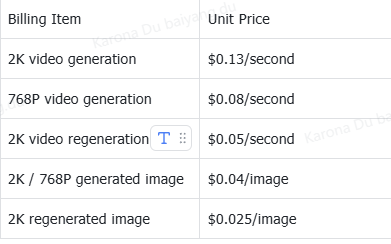
Billing is split into three components. Prompt enhancement is token-based at $0.9/1M input tokens and $3.6/1M output tokens. Video is billed by the second: $0.13/second for 2K generation, $0.08/second for 768P generation, and $0.05/second for 2K regeneration. Generated images are billed per image: $0.04/image through the 2K and 768P channels, and $0.025/image for 2K regeneration. A practical workflow is to generate a dozen or more drafts in 768P and regenerate only the selected cuts at 2K. The unit cost of that path is $0.08 plus $0.05, more than 30% cheaper than repeatedly generating directly at 2K.
Compared with MiniMax’s own hailuo 2.3 generation, H3’s main changes are the move from single-purpose video generation to omni-modal input, the addition of native stereo audio, an increase in resolution to 2K, and a separate lower-cost regeneration channel. Across the market, Artificial Analysis ranked H3 first in video editing and within the top three for both text-to-video and image-to-video on its August 3 leaderboard, making it the first open-weight model to take first place on that ranking. The pricing comparison is also straightforward: Sora 2 is approximately $0.30/second at 720P, Veo 3.1 Standard around $0.75/second, and Kling 3.0 Standard around $0.084/second with audio included. At $0.13/second for 2K, H3 sits among the lowest-priced options in the higher-resolution tier.
There is one important detail on open weights. MiniMax released the 33B H3-Base, but did not release the 2K regeneration or prompt-processing modules alongside it. The practical ceiling for local self-hosting is therefore 768P, and the configuration that tops the leaderboard is not the same as the publicly available weight package. For 2K output, API access is required.
Its strongest fit is bulk creative iteration for advertising, e-commerce, and game assets: take a product script, generate a dozen storyboard directions, then upgrade only the selected shots to 2K, without having to bolt on a separate TTS layer for voice.
text-embedding-v4: /v1/embeddings Endpoint Goes Live at $0.07/1M Input Tokens
On August 13, AF opened the /v1/embeddings endpoint, with Alibaba Tongyi’s text-embedding-v4 as the first embedding model available. The model ID is text-embedding-v4, priced at $0.07/1M input tokens. The API is OpenAI-compatible and available at https://api.agentsflare.com/v1/embeddings, with support for the dimensions and encoding_format parameters.
This is a multilingual unified embedding model from Tongyi Lab built on Qwen3. It covers more than 100 languages, with configurable vector dimensions from 64 to 2048; 1024 dimensions is a common balance between retrieval quality and storage cost. Each text can contain up to 8192 tokens, with up to 10 texts per request. In addition to conventional dense vectors, it supports task instructions (instruct) and sparse vectors. The former lets developers specify the retrieval scenario in a short English instruction, while the latter enables hybrid retrieval with keyword search.
Compared with v3, Alibaba states that performance improves by 15% to 40% across multilingual MTEB, Chinese-English, and code-retrieval evaluations. The shift from fixed to configurable dimensions is also one of the most practical engineering cost improvements: indexing the same corpus at 512 dimensions cuts vector-storage and similarity-computation overhead roughly in half compared with 1024 dimensions.
Across vendors, $0.07/1M sits at the low end of mainstream embedding-model pricing. OpenAI text-embedding-3-large costs $0.13/1M at 3072 dimensions, Google Gemini Embedding $0.15/1M at 3072 dimensions with a 2048-token per-text limit, and larger Voyage models around $0.18/1M. OpenAI text-embedding-3-small is cheaper at $0.02/1M, but is generally more reliable in English-only use cases; for mixed Chinese-English and multilingual corpora, text-embedding-v4 has a clearer retrieval-quality advantage. Its 8192-token per-text limit is also four times Gemini Embedding’s 2048-token limit, reducing the amount of chunking logic required for long documents.
The model serves as the foundation for RAG and semantic retrieval: enterprise knowledge bases, historical support-ticket retrieval, semantic matching for products and résumés, clustering, and classification labels. At $0.07/1M, vectorizing a full corpus of 1 billion tokens costs on the order of $70.
Retired Models and Migration Recommendations
The following 3 models have reached retirement and calls will fail directly:
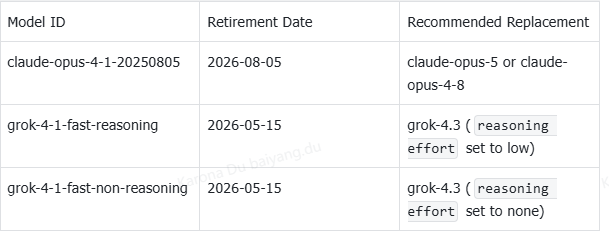
Migrating from claude-opus-4-1 is a favorable trade. The previous opus-4-1 cost $15.00/1M input and $75.00/1M output, with a 200K context window and 32K maximum output. claude-opus-5 and claude-opus-4-8 are both priced at $5.00/1M input and $25.00/1M output, with 1M context windows and 128K maximum output. Input and output pricing falls to one-third, while the context window expands fivefold. One migration detail matters: from opus-4.7 onward, sampling parameters have been tightened. Setting temperature, top_p, or top_k to non-default values returns a 400 error. Remove these parameters from the request during migration and control style through prompts instead.
The two grok-4-1-fast slugs need separate treatment. According to xAI’s retirement notice, requests sent to these slugs are automatically redirected to grok-4.3, which means existing code will not fail outright. However, billing switches to grok-4.3’s $1.25/$2.50 pricing rather than the original $0.20/$0.50, raising input cost by more than six times. Update the model field explicitly to grok-4.3 as soon as possible. For reasoning workloads, set reasoning effort to low; for non-reasoning workloads, set it to none. If the original reason for using these slugs was low cost, another model family may be more appropriate: gemini-3.5-flash-lite at $0.30/$2.50, gpt-5-nano at $0.05/$0.40, deepseek-v4-flash at $0.14/$0.28, or gemini-2.5-flash-lite at $0.10/$0.40. All are cheaper than grok-4.3. First align output quality in a test project before switching production traffic.
Upcoming Retirements: Timeline for 10 Models
On August 14, retirement dates for the following models were updated based on official lifecycle documentation from Microsoft Azure AI Foundry and Google Cloud. The closest deadline is August 31, so migration windows should be scheduled now:
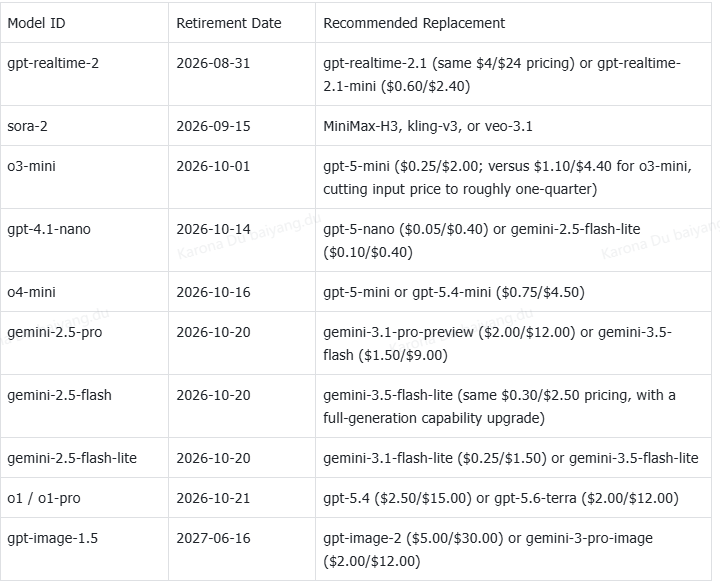
Among this group, the migration with the highest immediate benefit is gemini-2.5-flash. Old and new are both priced at $0.30/$2.50, so moving to gemini-3.5-flash-lite effectively delivers an entire generation of capability improvement at no additional unit cost. Replacements for the o1 family, o3-mini, and o4-mini are generally also cheaper, with the gpt-5 family offering stronger performance and better pricing on comparable tasks. sora-2 is the only migration likely to require meaningful engineering rework because video API parameters and output formats differ across providers. Allow two to three weeks for adaptation.
Pricing and Billing Comparison
In this issue, grok-4.6, gemini-3.5-flash-lite, and text-embedding-v4 are billed by token. MiniMax-H3 video is billed by second and image, while prompt enhancement is billed by token. Key model comparisons are below:
MiniMax-H3 video and image pricing is listed separately:
Reference pricing for video models over the same period: Sora 2 at approximately $0.30/second for 720P, Veo 3.1 Standard at approximately $0.75/second, and Kling 3.0 Standard at approximately $0.084/second.
Enterprise Model Selection Recommendations
Long-horizon agents and research workloads: grok-4.6 delivers an Intelligence Index score of 61 at $2.00/$6.00. For workflows such as contract review, cross-source research synthesis, and multi-step code refactoring—where the model needs to plan and then execute—the cost is more than 50% lower than same-tier GPT-5.6 Sol and claude-opus-5. Keep prompts below 200K to avoid moving the entire request into the higher pricing tier.
High-throughput execution layer: gemini-3.5-flash-lite combines $0.30/1M input pricing with 350 token/s, making it a good fit for bulk subtasks beneath a primary agent. For workloads that are more sensitive to output cost and need around 200K of context, MiniMax-M2.7 ($0.30/$1.20) is cheaper on the output side.
Video asset production: use MiniMax-H3 in a two-stage workflow—768P for iteration, 2K for final output. Native stereo audio removes the need for a separate dubbing layer. For brand content that requires stricter copyright and compliance review, it is still advisable to keep veo-3.1 or kling-v3 as an alternative path.
Retrieval and knowledge bases: use text-embedding-v4 to build indexes. At $0.07/1M, full re-indexing can become a routine operation rather than a one-off migration project. Choose dimensions based on corpus scale: 512 dimensions is generally sufficient for millions of documents; move to 1024 dimensions when the corpus reaches tens of millions or more.
On AF, these combinations can be implemented by creating a separate project for each task category. Each project can define its own model call order, primary and fallback models, and switch APIs without changing business code. Set budget ceilings and quotas independently by project—especially for video workloads billed by the second, where an uncontrolled batch-generation job can consume a month’s budget within hours. Permissions can also be allocated by team: content-production models for the creative team, while contract-review models remain available only to legal and risk teams. At month end, billing is automatically broken down by project, making it straightforward to see which workflow is delivering value for its cost.
To evaluate these models against your own business workloads, contact the AF team for testing credits. We can help assemble an initial model combination by task type and run the first round of tests.