Kimi K3 and GLM-4.6V Launch on AF: 1M-Context Flagship Tops WebDev, Vision Model Pricing Halved
Author
Agentsflare Admin
Date Published
If you read nothing else this week:
- AgentsFlare has added Kimi K3 and GLM-4.6v: Kimi K3 targets long-context, coding, and agentic workloads, while GLM-4.6v supports image understanding, document processing, and multimodal business applications.
- Kimi K3 focuses on 1M-token context and complex workloads: Built on an approximately 2.8-trillion-parameter MoE architecture, it is priced at $3 per million input tokens and $15 per million output tokens, making it suitable for repository-wide refactoring, long-document analysis, and extended agent workflows.
- GLM-4.6v cuts vision-model pricing by half compared with its predecessor: It costs $0.30 per million input tokens and $0.90 per million output tokens, supporting document extraction, image review, chart question answering, and high-volume visual processing.
- Enterprises should assign models according to workload complexity: Kimi K3 is suited to demanding long-horizon tasks, GLM-4.6v to high-volume vision workloads, and lower-cost models to routine batch processing. Teams should also migrate from the retired Claude 4 and Gemini preview models.
Main Copy
AF has added two models in this update: Z.ai’s GLM-4.6V vision model went live on July 15, with input and output pricing halved from the previous generation; Moonshot AI’s flagship Kimi K3 followed on July 20, offering a 1M-token context window and reaching No. 1 on the Arena WebDev leaderboard on its release day. Five legacy models were retired over the same period: claude-sonnet-4 and claude-opus-4 were discontinued on June 15, while three preview versions of Gemini 3.1 Flash and Gemini 3 Pro were discontinued between July 9 and July 17. Migration recommendations are provided below.
Daily Release List
July 15: GLM-4.6V (Z.ai’s vision model in the GLM-4.6 family, model ID glm-4.6v)
July 20: Kimi K3 (Moonshot AI’s flagship Kimi model, model ID kimi-k3)
Kimi K3: An Open-Source Flagship with 1M Context, Debuting at No. 1 on WebDev
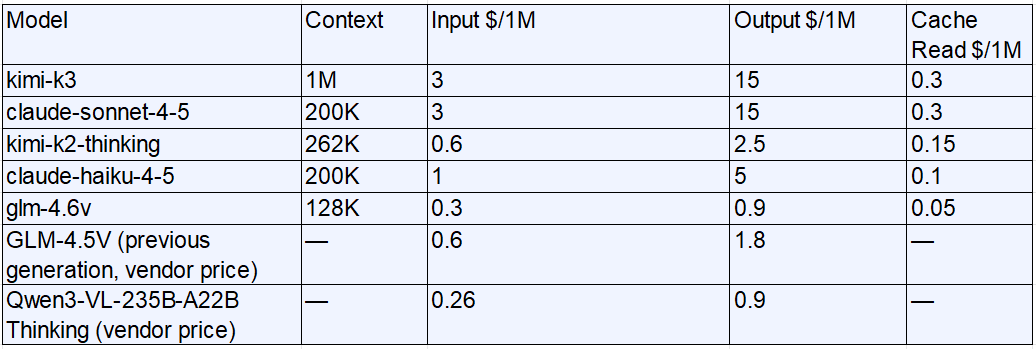
Moonshot AI released Kimi K3 on July 16, and AF made it available on July 20. It is the largest Kimi model to date, featuring a Mixture-of-Experts (MoE) architecture with approximately 2.8T total parameters, a 1M-token context window, a maximum output of 131K tokens, native vision capabilities, and compatibility with the OpenAI Chat Completions API. Pricing is $3.00/1M input tokens, $15.00/1M output tokens, and $0.30/1M cache-read tokens.
Compared with the previous-generation Kimi K2 Thinking, priced on AF at $0.60/$2.50 with a 262K context window, K3’s main advances are in engineering and agentic tasks: 76.8 versus 71.3 on SWE-bench Verified, 91.2 versus 88.0 on BrowseComp, an expansion of the context window from 262K to 1M, and a retention score of 90.4 in a 1M-token long-context evaluation. The tradeoff is a higher price tier, rising from $0.60/$2.50 to $3/$15. K2 Thinking remains available, giving the two generations a clear division of labor: K2 Thinking for routine batch workloads and K3 for heavy, long-horizon workflows.
In the broader market, K3 is priced exactly in line with Claude Sonnet 4.5—both at $3/$15, with cache reads at $0.30—while offering five times the context window, at 1M versus 200K. On its release day, K3 reached No. 1 on the Arena WebDev leaderboard with a score of 1679, ahead of Claude Fable 5 at 1631 and GPT-5.6 Sol at 1618. It ranked fourth on the Artificial Analysis overall leaderboard, behind Fable 5 and several GPT-5.6 variants. Overall, K3’s strengths lie in front-end code generation and long-horizon agent execution, while Anthropic’s and OpenAI’s flagship models remain stronger in deep reasoning.
Typical business use case: cross-repository code migration and refactoring. A medium-sized codebase, together with its issue history and dependency documentation, can be placed into the 1M-token context window so the model can plan the refactor and modify files within the full project context, reducing interface inconsistencies caused by context loss in segmented processing.
GLM-4.6V: A Vision Model with Input Pricing Halved to $0.30/1M
GLM-4.6V, the vision model in Z.ai’s GLM-4.6 family, became available on AF on July 15 under the model ID glm-4.6v. It supports multimodal conversational use cases such as image understanding and is compatible with the OpenAI Chat Completions API. Pricing is $0.30/1M input tokens, $0.90/1M output tokens, and $0.05/1M cache-read tokens.
The most immediate change in this generation is pricing. The previous-generation GLM-4.5V carried vendor pricing of $0.60/1M input tokens and $1.80/1M output tokens. GLM-4.6V halves both input and output pricing and adds a $0.05 cache-read tier. In capability terms, the vendor expanded the training context to 128K tokens and added native function calling. The model performs in the top tier among open-source models of a comparable scale on multimodal benchmarks including MMBench, MathVista, and ChartQAPro, and outperforms the larger Qwen3-VL-235B on long-document understanding tasks.
Among cross-vendor alternatives, the main open-source vision option at a similar price point is Alibaba’s Qwen3-VL family. Qwen3-VL-235B-A22B Thinking is priced by the vendor at approximately $0.26/1M input tokens and $0.90/1M output tokens, making it nearly identical in price to GLM-4.6V. GLM-4.6V differentiates itself through native tool calling and long-document performance, while Qwen3-VL offers a broader range of model sizes, with the 32B version starting at approximately $0.10/1M input tokens. For vision-model selection, enterprises should run both models against their own production samples; at this price level, the cost of experimentation is low.
Typical business use case: high-volume structuring of forms and technical drawings. For workloads such as insurance claim photo review, manufacturing quality-inspection report parsing, and retail product-image compliance checks, pricing of $0.30/1M input tokens reduces the cost of processing millions of image documents by an order of magnitude compared with one year ago.
Model Retirement Notice
The following five models have reached the end of their lifecycles and have now been retired:
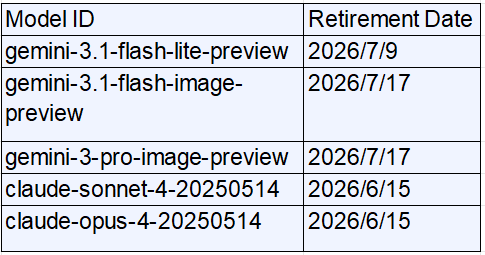
Requests still calling these IDs will fail, so migration should be completed as soon as possible. Claude 4 models can be migrated directly to claude-sonnet-4-5 or claude-haiku-4-5; Gemini 3.1 Flash preview models can be switched to the generally available gemini-3.5-flash or gemini-3.6-flash. Before moving production traffic, first validate output quality and cost in a test project.
Pricing and Billing Comparison
Both new models in this update are billed by token at the same rates as their vendors. Key model comparisons are shown below:
Enterprise Model Selection Recommendations
Long-horizon agents and coding tasks: Kimi K3 is well suited to heavy workloads that require large amounts of context in a single request, such as full-repository refactoring and long-document workflows. Routine code completion and batch processing should remain on Kimi K2 Thinking or GLM-4.6, where costs are more than five times lower.
Multimodal and document understanding: GLM-4.6V can cover core requirements for form parsing, chart question answering, and image review. In scenarios requiring exceptionally high accuracy, Claude Sonnet 4.5 can be used for sampling-based review, creating a two-tier structure in which a lower-cost model handles volume and a premium model provides quality control.
Conversational and general-purpose tasks: Claude Haiku 4.5 ($1/$5) remains a strong balance between quality and cost. Users of the retired Claude 4 models should upgrade directly to the 4.5 family.