AI Infra Weekly

Compute Expansion, Rising Sovereign Cloud Demand, and Accelerating Multi-Model Governance: Enterprise AI Infrastructure Moves Toward Control-Plane Competition

Author

AgentsFlare Research

Date Published

This week saw several major developments across the AI infrastructure layer, spanning the model layer, inference/cloud layer, data center investment, and the evolution of the open-source stack. What these changes have in common is a shift from “simply connecting to APIs” toward demand for a more mature AI access layer / scheduling layer / control plane. The five trends most worth watching this week include:

Executive summary

If you read nothing else this week:

  • Compute expansion and power constraints are becoming intertwined - Mistral, Meta, Crusoe, and other vendors announced data center construction plans ranging from hundreds of megawatts to gigawatts to support large-model inference. At the same time, constrained energy supply is pushing companies to sign “ratepayer protection pledges” and adopt self-built power generation models.
  • New models and open weights - Z.ai released GLM-5.1, Mistral released the Voxtral text-to-speech model, Cohere open-sourced Transcribe, and Google introduced Gemini 3.1 Flash-Lite. New models generally offer flexible reasoning and longer context, while some are using open-source or low-price strategies to attract enterprises.
  • Cloud infrastructure is diversifying, and sovereign cloud demand is rising - Ampere launched cloud instances based on its AmpereOne Arm processor series, while Oracle, Scaleway, and others expanded in Europe. This reflects the trade-off enterprises are making between energy efficiency and data sovereignty. Veritone also signed a multi-year agreement with Oracle to migrate core AI workloads to OCI in search of performance and cost advantages.
  • AI cloud pricing innovation - CoreWeave launched a hybrid pricing model combining “Flex Reservations” and “Spot,” enabling enterprises to balance cost flexibly between inference peaks and idle periods. Flexible pricing, not only GPU supply, has become the new normal.
  • Policy and security developments - A U.S. court ordered the government to withdraw its supply-chain risk designation against Anthropic, reminding enterprises to pay close attention to model regulation. Major cloud vendors also signed a “Ratepayer Protection Pledge,” promising to fund grid upgrades out of pocket. This suggests that enterprise power-cost governance will become a key criterion in vendor selection.

Key Developments

Model and API Layer

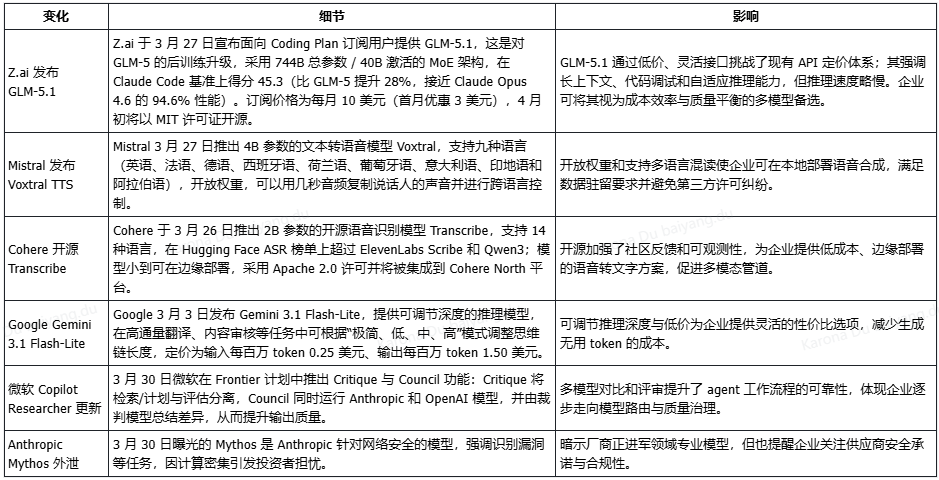
Z.ai releases GLM-5.1: On March 27, Z.ai announced that GLM-5.1 would be available to Coding Plan subscribers. GLM-5.1 is a post-training upgrade to GLM-5, using a 744B-total-parameter / 40B-active MoE architecture. It scored 45.3 on the Claude Code benchmark, a 28% improvement over GLM-5 and close to 94.6% of Claude Opus 4.6 performance. The subscription price is $10 per month, with a first-month promotional price of $3, and the model is scheduled to be open-sourced under the MIT license in early April.

GLM-5.1 challenges existing API pricing systems through low cost and flexible interfaces. It emphasizes long context, code debugging, and adaptive reasoning capabilities, although inference speed is slightly slower. Enterprises can view it as a multi-model alternative that balances cost efficiency and quality.

Mistral releases Voxtral TTS: On March 27, Mistral launched Voxtral, a 4B-parameter text-to-speech model. It supports nine languages - English, French, German, Spanish, Dutch, Portuguese, Italian, Hindi, and Arabic - and provides open weights. The model can clone a speaker’s voice using a few seconds of audio and enable cross-lingual control.

Open weights and support for multilingual code-switching allow enterprises to deploy speech synthesis locally, meet data-residency requirements, and avoid third-party licensing disputes.

Cohere open-sources Transcribe: On March 26, Cohere released Transcribe, a 2B-parameter open-source speech recognition model. It supports 14 languages and surpassed ElevenLabs Scribe and Qwen3 on the Hugging Face ASR leaderboard. The model is small enough for edge deployment, uses the Apache 2.0 license, and will be integrated into the Cohere North platform.

Open source strengthens community feedback and observability. It gives enterprises a low-cost, edge-deployable speech-to-text option and promotes multimodal pipelines.

Google Gemini 3.1 Flash-Lite: On March 3, Google released Gemini 3.1 Flash-Lite, a reasoning model with adjustable reasoning depth. For high-throughput tasks such as translation and content moderation, it can adjust chain-of-thought length across “minimal, low, medium, and high” modes. Pricing is $0.25 per million input tokens and $1.50 per million output tokens.

Adjustable reasoning depth and low pricing give enterprises a flexible cost-performance option and reduce the cost of generating unnecessary tokens.

Microsoft updates Copilot Researcher: On March 30, Microsoft introduced Critique and Council features in the Frontier program. Critique separates retrieval/planning from evaluation. The council runs Anthropic and OpenAI models simultaneously and uses a judge model to summarize differences, thereby improving output quality.

Multi-model comparison and review improve the reliability of agent workflows and show that enterprises are gradually moving toward model routing and quality governance.

Anthropic Mythos leaks: The Mythos model disclosed on March 30 is Anthropic’s cybersecurity-focused model, emphasizing tasks such as vulnerability identification. Its compute intensity has raised investor concerns.

This suggests that vendors are entering domain-specific models, but it also reminds enterprises to pay attention to vendor security commitments and compliance.

Cloud and Inference Layer

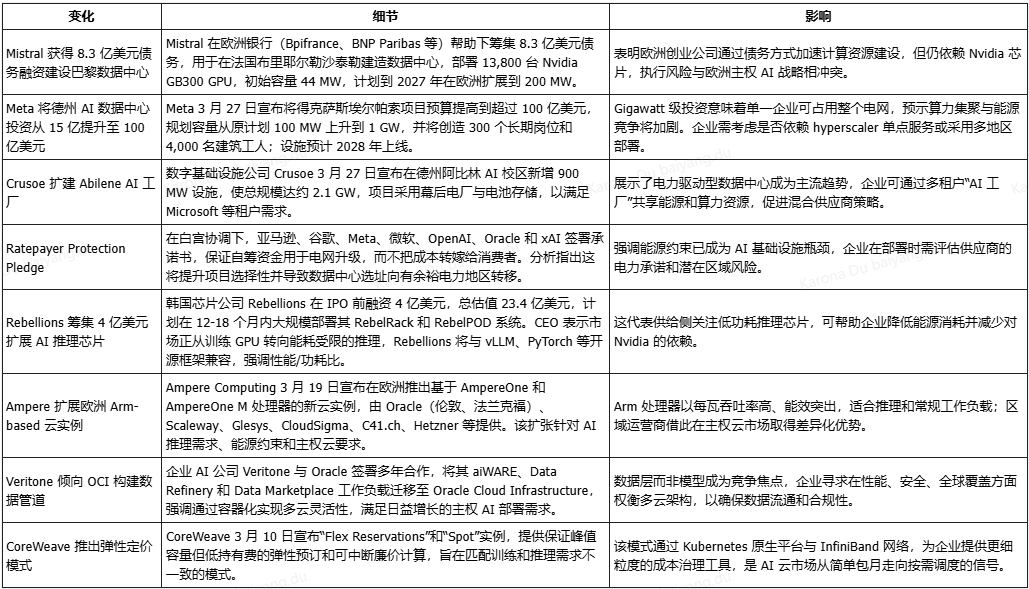
Mistral secures $830 million in debt financing to build a Paris data center: With support from European banks including Bpifrance and BNP Paribas, Mistral raised $830 million in debt financing to build a data center in Bruyères-le-Châtel, France. The facility will deploy 13,800 Nvidia GB300 GPUs, begin with 44 MW of capacity, and is planned to expand to 200 MW across Europe by 2027.

This shows that European startups are accelerating compute-resource buildout through debt financing, but they still rely on Nvidia chips. Execution risk may conflict with Europe’s sovereign AI strategy.

Meta raises its Texas AI data center investment from $1.5 billion to $10 billion: On March 27, Meta announced that it would increase the budget for its El Paso, Texas project to more than $10 billion. Planned capacity will rise from the original 100 MW to 1 GW. The project will create 300 long-term roles and 4,000 construction jobs, with the facility expected to come online in 2028.
Gigawatt-scale investment means a single company may occupy an entire grid. This indicates intensifying compute concentration and energy competition. Enterprises need to consider whether to rely on a single hyperscaler service or adopt multi-region deployment.

Crusoe expands the Abilene AI Factory: On March 27, digital infrastructure company Crusoe announced that it would add a 900 MW facility to its AI campus in Abilene, Texas, bringing the total scale to about 2.1 GW. The project uses behind-the-meter power generation and battery storage to meet demand from tenants such as Microsoft.
This shows that power-driven data centers are becoming mainstream. Enterprises can share energy and compute resources through multi-tenant “AI factories,” supporting a hybrid supplier strategy.

Ratepayer Protection Pledge: Under White House coordination, Amazon, Google, Meta, Microsoft, OpenAI, Oracle, and xAI signed a pledge to guarantee that they would self-fund grid upgrades rather than pass the costs on to consumers. Analysts noted that this could make project selection more selective and shift data center siting toward regions with surplus electricity.
This emphasizes that energy constraints have become a bottleneck for AI infrastructure. Enterprises must evaluate suppliers’ power commitments and potential regional risks when deploying AI systems.

Rebellions raised $400 million to expand AI inference chips: Korean chip company Rebellions raised $400 million in pre-IPO financing at a total valuation of $2.34 billion. It plans to deploy its RebelRack and RebelPOD systems on scale within 12 to 18 months. The CEO said the market is shifting from training GPUs to power-constrained inference. Rebellions will be compatible with open-source frameworks such as vLLM and PyTorch and emphasize performance-per-watt.
This shows that the supply side is focusing on low-power inference chips, which can help enterprises reduce energy consumption and lessen dependence on Nvidia.

Ampere expands European Arm-based cloud instances: On March 19, Ampere Computing announced new cloud instances in Europe based on AmpereOne and AmpereOne M processors. Providers include Oracle in London and Frankfurt, Scaleway, Glesys, CloudSigma, C41.ch, and Hetzner. The expansion targets AI inference demand, energy constraints, and sovereign cloud requirements.
Arm processors offer high throughput per watt and strong energy efficiency, making them suitable for inference and general workloads. Regional operators can use them to differentiate in the sovereign cloud market.

Veritone leans into OCI to build data pipelines: Enterprise AI company Veritone signed a multi-year agreement with Oracle to migrate its aiWARE, Data Refinery, and Data Marketplace workloads to Oracle Cloud Infrastructure. The company emphasized containerization for multi-cloud flexibility and to meet growing demand for sovereign AI deployments.
The data layer, rather than the model itself, is becoming the competitive focus. Enterprises are seeking to balance performance, security, and global coverage through multi-cloud architecture to ensure data flow and compliance.

CoreWeave launches flexible pricing model: On March 10, CoreWeave announced “Flex Reservations” and “Spot” instances, offering elastic reservations that guarantee peak capacity with lower holding fees, as well as interruptible low-cost compute. The goal is to match the mismatch between training and inference demand patterns.
Through its Kubernetes-native platform and InfiniBand networking, this model gives enterprises more granular cost-governance tools. It is a signal that the AI cloud market is moving from simple monthly packages toward on-demand scheduling.

Open-Source Infrastructure and Engineering Stack

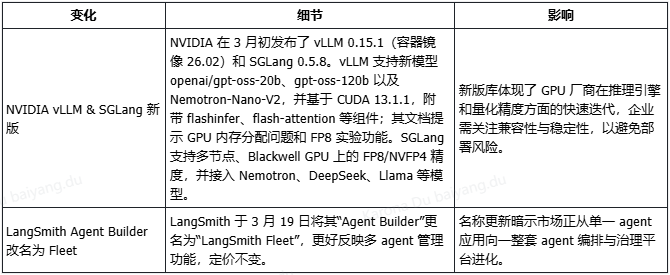
New NVIDIA vLLM and SGLang releases: In early March, NVIDIA released vLLM 0.15.1 (container image 26.02) and SGLang 0.5.8. vLLM supports new models including openai/gpt-oss-20b, gpt-oss-120b, and Nemotron-Nano-V2. It is based on CUDA 13.1.1 and includes components such as flashinfer and flash-attention; its documentation flags GPU memory-allocation issues and experimental FP8 features. SGLang supports multi-node operation, FP8/NVFP4 precision on Blackwell GPUs, and integrations with models such as Nemotron, DeepSeek, and Llama.

The new library releases reflect rapid iteration by GPU vendors in inference engines and quantization precision. Enterprises need to pay attention to compatibility and stability to avoid deployment risk.

LangSmith Agent Builder renamed Fleet: On March 19, LangSmith renamed its “Agent Builder” to “LangSmith Fleet” to better reflect multi-agent management capabilities. Pricing remains unchanged.

The name change suggests that the market is evolving from single-agent applications toward a full set of agent orchestration and governance platforms.

What It Means for Enterprises

Power and cost are becoming sensitive selection criteria. Gigawatt-scale data center investment and the “Ratepayer Protection Pledge” show that AI platform vendors will increasingly differentiate around energy access and cost absorption. If enterprises choose hyperscaler services, they need to assess regional power guarantees and cost pass-through strategies. If they adopt dedicated or regionalized clouds, such as Crusoe “AI factories” or Ampere-based sovereign clouds, they can reduce risk through lower power consumption and localized compliance.

Multi-model routing and quality evaluation are entering practical deployment. Microsoft Copilot Researcher’s Critique/Council, the cost-performance profile of Z.ai GLM-5.1, and the Anthropic Mythos leak all suggest that enterprises are no longer satisfied with a single large model. They need to switch among multiple models based on tasks and establish automated review mechanisms. This trend requires building an AI Gateway or Orchestration Layer for model selection, fallback, quality monitoring, prompt optimization, and security audit.

The data layer and governance are more important than the model itself. Veritone’s partnership with Oracle, the software-centric architecture advocated by Rebellions, and Cohere’s open-source ASR all emphasize that value lies in the extraction, transformation, and distribution of data pipelines, not only in models. This requires enterprises to invest in data governance, stream processing, and observability platforms, while evaluating cloud providers’ commitments to data sovereignty.

Cloud pricing and compute supply are fragmenting. CoreWeave’s flexible pricing, Ampere’s Arm instances, and the rapid iteration of vLLM and SGLang show that the AI cloud supply market is splitting from a small number of large general-purpose platforms into multi-layered supply, including dedicated GPU clouds, Arm clouds, and edge inference. Enterprises need to optimize their supplier mix based on cost / performance / risk combinations and pay attention to lock-in risk.

Security and compliance controls are rising at the same time. Anthropic’s regulatory dispute, the Mythos model leak, and the Ratepayer Protection Pledge remind enterprises to watch legal and policy risks, including supply-chain security, data leakage, copyright compliance, and power regulation. When selecting suppliers and models, enterprises must evaluate compliance and audit capabilities.

Against this backdrop, the value of enterprise-grade AI Gateways / Control Planes such as AgentsFlare will continue to rise. The reason is not simply that they connect more models, but that they help enterprises bring multi-model calls, routing strategies, access control, audit logs, and cost governance into a unified infrastructure layer rather than leaving them scattered across different vendor backends.

Strategic Takeaways

Establish a power and cost governance strategy. Over the next 18 months, energy supply and electricity prices will shape the cost of AI deployment. Enterprises should review suppliers’ commitments to grid investment and renewable energy, consider working with suppliers that own self-built power plants or distributed energy sources, and specify electricity-cost responsibilities in contracts.

Embrace multi-model architecture and model routing. As new models iterate frequently and performance/price differences become clear, the single-model era is ending. Enterprises should build a model routing layer that supports multi-model combinations, automatic fallback, and quality evaluation. They can use tools such as LangSmith Fleet and open-source orchestrators, or consider building their own, in order to ensure stability and cost control for sensitive tasks.

Invest in data pipelines and observability. Requirements for data sovereignty, privacy protection, and audio/video processing continue to rise. Enterprises need to build a unified layer for data extraction, cleaning, labeling, and access, supported by real-time monitoring and cost-analysis tools, to ensure model input quality and compliance. The Veritone-Oracle partnership reminds us that containerization and multi-cloud migration capabilities are key to achieving data flexibility.

Pay attention to hardware diversification. Updates from Ampere, Rebellions, and Nvidia vLLM/SGLang show that the hardware layer is diversifying. Arm CPUs, dedicated inference chips, and Blackwell GPUs will jointly shape the future of AI infrastructure. In procurement, enterprises should evaluate performance per watt, ecosystem compatibility, and supply-chain stability, and avoid blindly pursuing a single GPU model.

Prepare security, compliance, and agent governance in advance. The new regulatory environment, model leaks, and judicial rulings mean enterprises need full-chain management from supplier due diligence to model output review. Security agents, log audits, and access controls should be incorporated into architecture design rather than relying on default settings in third-party platforms.

For enterprises already in production, an increasingly realistic judgment is that future competition may not be about “which model is strongest,” but rather “who owns the more mature control plane.” This is also the product logic behind AgentsFlare: through unified access, intelligent routing, tiered permissions, cost monitoring, and observability, it helps enterprises turn model capabilities into sustainable production systems.

Bridge to Action

Consulting and strategic planning: If an enterprise is planning its AI infrastructure roadmap for 2026-2027, it should map the four dimensions of cost, performance, compliance, and power, and compare suppliers across them. AgentsFlare can provide in-depth assessments of sovereign cloud, AI factory cooperation models, and GPU / Arm / inference-chip selection.

Build an AI Gateway / multi-model scheduling layer: For enterprises that need to integrate multiple models and enable permission management, AgentsFlare’s multi-model routing and observability capabilities can be used to build an in-house “control plane.” The platform supports cost monitoring, rate limiting, prompt tuning, permissions, and audit logs, helping enterprises remain stable and reliable in a complex model and API ecosystem.

Strengthen data and security governance: When adopting open-source models or deploying across regions, enterprises should review full-lifecycle security for data flows, including training data sources, privacy protection during inference, and copyright compliance for generated content. AgentsFlare can help enterprises implement fine-grained access control and tracing mechanisms, while also providing anomaly detection to ensure security and compliance.

Monitor market and policy changes: AI infrastructure is evolving rapidly, and new models, pricing mechanisms, or policies may emerge every week. Enterprises can subscribe to AI Infra Weekly and build an internal radar to adjust procurement strategies in time. For major decisions, they can use AgentsFlare’s consulting services for deeper analysis and implementation planning.

This week’s developments show that the AI infrastructure layer has become an important battlefield for enterprise competition. Successful deployment depends not only on the model itself, but also on full-stack capabilities across power, data, cost, and governance. Enterprises need to proactively build a long-term strategy rather than passively chase hot topics.

References

Mistral AI Lands $830M for AI Data Center

Crusoe, Microsoft Expand Abilene AI Campus, Add 900 MW

China's Z.ai Launches GLM-5.1, Closing Gap With Claude Opus at a Fraction of the Cost — But Real-World Users Expose Critical Fault Lines

Mistral AI Launches Text-to-Speech Model

Cohere Unveils Open Source Speech Model for Edge Devices

Gemini 3.1 Flash-Lite Offers Choice on How It Processes Inputs

Ampere Expands European Cloud Amid Sovereign Cloud Demand

Veritone Leans Into Oracle Cloud to Scale AI Data Pipelines

CoreWeave’s Flexible Cloud Pricing Model Signals Strategic Shift

Anthropic Wins Injunction Against Trump Administration Over Defense Department Saga

Trump Admin’s Ratepayer Pledge: What It Means for Hyperscalers

Microsoft Brings New AI Capabilities to Copilot Researcher

What Anthropic Mythos Means for the AI Lab and Businesses

Meta Ups Texas AI Data Center Investment From $1.5B to $10B

Rebellions Raises $400M to Scale AI Inference Infrastructure

vLLM Release 26.02 - NVIDIA Docs

SGLang Release 26.02 - NVIDIA Docs

LangChain Changelog: Agent Builder is now LangSmith Fleet